

Archive position — measured, not model output
0 likes on Devpost
2,263 of the 7,850 archived projects have more likes, and 5,587 share exactly 0 — so this project's #2,849 place in the like-ranked listing is a tie-break inside that group, not a ranking.
Projects (log scale)
Likes on Devpost. ▲ marks this project's group.
Show the figures
| Likes | Projects | Share of archive |
|---|---|---|
| 0 | 5,587 | 71.2% |
| 1 | 1,758 | 22.4% |
| 2 | 284 | 3.6% |
| 3–4 | 132 | 1.7% |
| 5–9 | 75 | 1.0% |
| 10+ | 14 | 0.2% |
 User Stories BotA demo video on every pull request
Get a demo video on every new feature
GitHub App that watches your pull requests and records a narrated, captioned demo.
Save time on demo prep and make informed decisions faster with a video walkthrough of every new feature.
Executive Summary
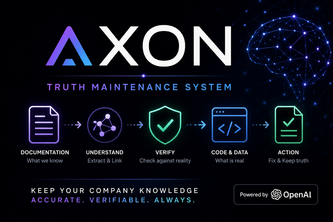
What the company appears to be: Axon is a self-reported AI-powered Truth Maintenance System designed to continuously verify organizational knowledge against implementation reality, detect drift, and propose fixes before misinformation spreads.
What changed: The project was submitted as part of the OpenAI 2026 hackathon. It represents an early-stage prototype built by one person (Vishal Goyal) with a focus on GitHub repository integration.
Single most important open question: Is there evidence that Axon can reliably detect documentation drift at scale, or does it remain a proof-of-concept?
Analysis basis: This report is based entirely on the self-reported project description provided by the author. No independent verification, traction data, revenue figures, customer information or third-party sources are available.
What The Product Actually Is
The description states that Axon:
- Connects to a GitHub repository
- Extracts documentation and source code
- Builds structured knowledge from both
- Verifies documentation claims against implementation
- Detects documentation drift
- Explains contradictions with supporting evidence
- Prioritizes findings by severity
- Uses GPT-5.6, Codex, OpenAI Embeddings, FastAPI backend, Next.js frontend, PostgreSQL with pgvector, Docker, AWS EC2 deployment, and GitHub API integration
Inference: The system appears to be a developer tool aimed at reducing knowledge drift in engineering teams by using AI to cross-check documentation against actual code.
Positioning & Claim Evolution
The author claims:
- Axon is not another documentation bot
- It's designed as an AI-powered Truth Maintenance System
- It continuously verifies organizational knowledge against reality
- It surfaces evidence-backed contradictions before they become costly mistakes
- It prioritizes findings by severity
- It works beyond GitHub to include Notion, Slack, Jira, Confluence
Claim vs Fact: These are self-descriptions of intent and positioning. No evidence of actual usage or impact is provided.
Target Customer & ICP
The description states:
- The problem it solves affects "every engineering team"
- It addresses documentation drift issues in configuration changes, API evolution, authentication mechanisms, and infrastructure modernization
- It targets engineers who lose trust in internal knowledge and spend time figuring out what is actually true
Inference: The primary customer segment appears to be engineering teams within organizations that rely heavily on documentation and codebases.
Business Model & Pricing Evidence
Not evidenced. The description does not contain any information about pricing, monetization strategy, or business model.
Technical & Delivery Signals
The author states:
- Built with GPT-5.6 and Codex for development acceleration
- Uses OpenAI Embeddings for semantic retrieval
- FastAPI backend, Next.js frontend
- PostgreSQL with pgvector
- SQLAlchemy + Alembic
- Docker & Docker Compose
- AWS EC2 deployment
- GitHub API integration
- Background workers for repository analysis
Inference: The technical stack suggests a modern, scalable architecture suitable for production use, though no evidence of actual deployment or performance metrics is given.
Traction & Maturity Signals
Not evidenced. There is no mention of users, customers, revenue, adoption, or usage statistics beyond the hackathon submission.
Competitive Context
Not evidenced. The description does not reference competitors or market positioning relative to existing tools in the documentation drift detection space.
Open Questions & Risks
- Single-person team: Only one member (Vishal Goyal) is listed, suggesting limited capacity for scaling or maintenance.
- Hackathon prototype: Submitted as a hackathon project; no indication of long-term viability or product-market fit.
- Unverified claims: The system's ability to reliably detect drift and reduce false positives remains unproven.
- Limited scope: Currently only supports GitHub repositories, with future integrations described but not implemented.
- AI dependency: Heavy reliance on GPT-5.6 and Codex raises questions about scalability, cost, and consistency.
Questions the description leaves open
- What specific documentation drift issues have you observed in real-world engineering teams?
- How does Axon handle false positives during verification?
- Have you tested Axon on large-scale repositories or enterprise-level codebases?
- What is the expected timeline for integrating other knowledge sources like Notion, Jira, Confluence?
- Is there a plan to monetize this tool, and if so, how?
- How do you intend to scale beyond the current single-developer model?
Overall Assessment
Not evidenced. No information is provided regarding funding rounds, valuation, or investment interest.
Confidence level: Low — this analysis is based solely on a self-reported hackathon submission with no evidence of traction, revenue, or customer validation. The project appears to be an early-stage prototype with significant unknowns around reliability, scalability, and commercial viability.
User Stories BotA demo video on every pull request
Get a demo video on every new feature
GitHub App that watches your pull requests and records a narrated, captioned demo.
Save time on demo prep and make informed decisions faster with a video walkthrough of every new feature.
Source
Submitted to the OpenAI 2026 hackathon on Devpost. Project home on Devpost. Back to the full gallery on Devpost.
This competitive analysis was produced by top-founders.com (opens in a new tab)
Generated by a language model from this project's public Devpost page — its tagline, the author's own write-up and any built-with tags listed there — as captured in August 2026. Short quotations are the author's words. It is an opinion on the idea as a business, not on the people behind it, and it reflects the description as published then. If the project has moved on, request a correction below. The analysis is not independent research and contains no verified traction, revenue or customer data.
An independent guide by KFG International LLC — not affiliated with, endorsed by, or connected to Devpost or OpenAI.