

Archive position — measured, not model output
0 likes on Devpost
2,263 of the 7,850 archived projects have more likes, and 5,587 share exactly 0 — so this project's #2,594 place in the like-ranked listing is a tie-break inside that group, not a ranking.
Projects (log scale)
Likes on Devpost. ▲ marks this project's group.
Show the figures
| Likes | Projects | Share of archive |
|---|---|---|
| 0 | 5,587 | 71.2% |
| 1 | 1,758 | 22.4% |
| 2 | 284 | 3.6% |
| 3–4 | 132 | 1.7% |
| 5–9 | 75 | 1.0% |
| 10+ | 14 | 0.2% |
 User Stories BotA demo video on every pull request
Get a demo video on every new feature
GitHub App that watches your pull requests and records a narrated, captioned demo.
Save time on demo prep and make informed decisions faster with a video walkthrough of every new feature.
Executive Summary
What the company appears to be
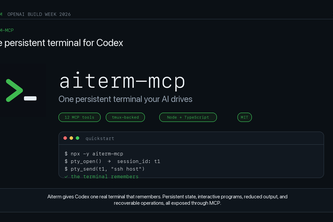
Aiterm is a self-reported local stdio MCP server that provides persistent terminal sessions for Codex and other MCP clients. It uses tmux to maintain state across tool calls, including working directories, environment variables, SSH connections, and long-running processes.
What changed
The author states that Aiterm existed before Build Week but was meaningfully extended during the submission window with features like safe serialized delivery for long PTY input, managed interactive agent launchers, correlated operation IDs, and hardened readiness gates. These additions appear to improve reliability, recovery, and orchestration.
Single most important open question
Is there any evidence of real-world usage or adoption beyond the author’s own development environment?
What The Product Actually Is
The description states that Aiterm is a local stdio MCP server that gives Codex and other MCP clients a real, persistent terminal backed by tmux. It supports:
- Opening one PTY
- Changing directories
- Exporting variables
- Authenticating to SSH once
- Entering containers or REPLs
- Starting long-running processes
- Continuing sessions across tool calls
It also provides:
- Token-reduced reads that preserve useful evidence while folding noisy output
- Five-layer completion detection (process exit, explicit marks, expected output, quiescence, timeout)
- Interactive launchers for Codex and other coding-agent TUIs
- Structured launch and close receipts for reliable orchestration and retry
- A destructive-command tripwire with an override
- Human co-driving through the same tmux session
The server is written in TypeScript on Node.js, using the Model Context Protocol SDK. It communicates with tmux via send-keys, buffers, and capture-pane, reserving stdout for MCP JSON-RPC.
Evidence
- The author describes Aiterm as a local stdio MCP server.
- It integrates with tmux to maintain terminal state.
- It supports interactive workflows like SSH, Docker, REPLs, and TUIs.
- It includes mechanisms for completion detection, recovery, and structured receipts.
Inference Aiterm appears to be a developer tool aimed at enabling persistent, stateful interactions within terminal environments for AI agents. However, no evidence of actual deployment or usage beyond the author’s own development is provided.
Positioning & Claim Evolution
The author positions Aiterm as a solution to a recurring problem in agent-based coding workflows: disposable shells that reset state between tool calls. The core claim is that:
“A terminal is naturally stateful. I wanted agents to have that same continuity without inventing a separate tool for every environment.”
This suggests a shift from fragmented, protocol-specific tools toward a unified, persistent terminal interface.
The project evolved during Build Week with:
- Safe serialized delivery for long PTY input
- Managed interactive agent launcher with bounded result recovery
- Correlated operation IDs to prevent duplicate or misattributed results
- Machine-readable launch and idempotent close receipts
- Hardened readiness gate to avoid prompt disappearance
These enhancements indicate a move from basic functionality to robustness, reliability, and integration with broader agent ecosystems.
Evidence
- The author describes the original problem as “disposable shells” resetting state.
- The evolution shows increasing focus on recovery, orchestration, and consistency.
Inference Aiterm evolved from solving a specific pain point into a more structured tool for managing complex terminal-based AI workflows. However, no evidence of market positioning or external feedback is provided.
Target Customer & ICP
The description states that Aiterm targets Codex and other MCP clients, which implies it is built for developers working with AI agents in terminal environments.
It supports:
- SSH sessions
- Docker containers
- REPLs
- TUIs (text-based user interfaces)
- Long-running processes
This suggests a target audience of:
- Developers building or using AI coding agents
- Teams integrating AI into development workflows
- Users who rely on persistent, interactive terminal sessions
Evidence
- The product is designed for Codex and MCP clients.
- It supports SSH, Docker, REPLs, and TUIs.
Inference The ICP likely includes developers working with AI agents in local environments. However, no evidence of actual customers or user personas exists.
Business Model & Pricing Evidence
Not evidenced.
Evidence No mention of pricing, monetization strategy, or business model in the description.
Inference There is no indication whether Aiterm will be sold, offered as open source, or used internally. No revenue streams or commercial plans are described.
Technical & Delivery Signals
The author reports:
- Built with TypeScript on Node.js
- Uses the Model Context Protocol SDK
- Communicates with tmux via
send-keys, buffers, andcapture-pane - Reserves stdout for MCP JSON-RPC
- Implements a 262-test regression suite covering normal operation, races, malformed events, security boundaries, recovery, and tmux integration
The design intentionally keeps the primitive small:
- Open, send, read, key, list, close
State is kept in the PTY rather than in tool-specific abstractions.
Evidence
- The implementation uses Node.js, TypeScript, and tmux.
- It includes a test suite of 262 tests.
- It supports core terminal operations with minimal abstraction.
Inference The technical architecture suggests a lightweight, focused tool designed for integration into larger AI agent systems. No evidence of scalability or production deployment is provided.
Traction & Maturity Signals
Not evidenced.
Evidence No data on users, adoption, revenue, or product usage is included in the description.
Inference There is no indication that Aiterm has been adopted beyond the author’s own use. No metrics, customer feedback, or market traction are reported.
Competitive Context
Not evidenced.
Evidence No mention of competitors or competitive landscape.
Inference While Aiterm appears to address a niche in AI agent tooling, there is no evidence of existing solutions or how it compares to them.
Open Questions & Risks
- No real-world usage: The product is described only as a personal project with no evidence of adoption.
- Single-person team: Only one member (K T) is listed, raising questions about scalability and long-term maintenance.
- Limited commercial viability: No pricing or monetization strategy is evident.
- Unproven market fit: No customer feedback or traction data to validate demand.
- High technical complexity for niche use case: The focus on tmux integration and MCP protocol may limit its applicability.
Evidence
- Team size: 1
- No mention of users, customers, or revenue
- No commercial strategy
Inference Aiterm is a proof-of-concept or personal project with no clear path to market traction or commercial viability. Its narrow focus and lack of external validation raise concerns about long-term relevance.
Questions the description leaves open
- What specific workflows or use cases are you targeting with Aiterm?
- Have you tested it in real-world scenarios beyond your own development environment?
- Are there any known limitations or edge cases that could prevent broader adoption?
- How do you plan to scale or monetize this tool if at all?
- What is the long-term vision for Aiterm beyond Build Week?
Overall Assessment
Not evidenced.
Evidence No financial data, funding rounds, valuation, or investment interest are mentioned.
Inference Given the lack of traction, revenue, or commercial strategy, there is no clear basis to recommend investment or partnership. The project appears to be a personal or experimental effort with no demonstrated market demand or scalability potential.
User Stories BotA demo video on every pull request
Get a demo video on every new feature
GitHub App that watches your pull requests and records a narrated, captioned demo.
Save time on demo prep and make informed decisions faster with a video walkthrough of every new feature.
Source
Submitted to the OpenAI 2026 hackathon on Devpost. Project home on Devpost. Back to the full gallery on Devpost.
This competitive analysis was produced by top-founders.com (opens in a new tab)
Generated by a language model from this project's public Devpost page — its tagline, the author's own write-up and any built-with tags listed there — as captured in August 2026. Short quotations are the author's words. It is an opinion on the idea as a business, not on the people behind it, and it reflects the description as published then. If the project has moved on, request a correction below. The analysis is not independent research and contains no verified traction, revenue or customer data.
An independent guide by KFG International LLC — not affiliated with, endorsed by, or connected to Devpost or OpenAI.