

Archive position — measured, not model output
0 likes on Devpost
2,263 of the 7,850 archived projects have more likes, and 5,587 share exactly 0 — so this project's #2,511 place in the like-ranked listing is a tie-break inside that group, not a ranking.
Projects (log scale)
Likes on Devpost. ▲ marks this project's group.
Show the figures
| Likes | Projects | Share of archive |
|---|---|---|
| 0 | 5,587 | 71.2% |
| 1 | 1,758 | 22.4% |
| 2 | 284 | 3.6% |
| 3–4 | 132 | 1.7% |
| 5–9 | 75 | 1.0% |
| 10+ | 14 | 0.2% |
 User Stories BotA demo video on every pull request
Get a demo video on every new feature
GitHub App that watches your pull requests and records a narrated, captioned demo.
Save time on demo prep and make informed decisions faster with a video walkthrough of every new feature.
Executive Summary
What the company appears to be
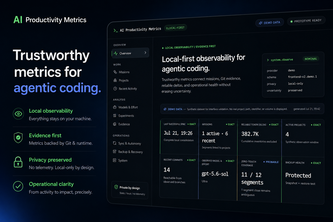
The author describes a local-first observability system for agentic software engineering. The product tracks Codex missions, Git activity, model usage, token checkpoints, and outcomes, aiming to produce trustworthy, privacy-preserving metrics. It is built as a zero-touch, local-first tool with no permanent server or telemetry.
What changed
The project evolved from a small prototype into a structured system during OpenAI Build Week, incorporating Codex and GPT-5.6 for development. It now includes automated testing, SQLite-based storage, and a React/TypeScript frontend prototype.
Single most important open question — the commercial due-diligence read
Is there a market need for this type of local-first observability in agentic coding workflows? The description does not indicate any customers or revenue; traction is not evidenced.
What The Product Actually Is
The description states that AI Productivity Metrics is an observability system for agentic software engineering. It connects evidence from:
- Codex root threads and subagent relationships;
- Agentic missions, execution segments, interruptions, and resumes;
- Models used, effort levels, and token checkpoints;
- Git repositories, commits, files, and deliverables;
- Project discovery and stable repository identities;
- Synchronization freshness and zero-touch coverage;
- Subscription periods and longitudinal experiments;
- Backup integrity and tested disaster recovery.
It stores structured state in SQLite, reads Codex metadata in read-only mode, and uses Git for repository-grounded evidence. The system separates reliable evidence from diagnostic data and distinguishes between exact, probable, ambiguous, and unknown values.
It is built with Python (core), React/TypeScript (frontend prototype), and various tools including Node.js, Playwright, OpenAI APIs, and Qwen3-TTS.
Inference The product appears to be a local-first tool for tracking and measuring agentic coding workflows, designed to provide trustworthy metrics without cloud telemetry or permanent watchdogs.
Positioning & Claim Evolution
The author claims that the system answers the question: "What did the agents actually deliver?" It is positioned as a zero-touch, local-first observability platform for agentic coding. The goal is to connect Codex missions, models, token checkpoints, Git activity, and outcomes into trustworthy, privacy-preserving metrics.
The project evolved from a small prototype into a structured system during OpenAI Build Week. It now includes more than 500 automated tests and supports mission-level tracking, attribution across projects, and handling interruptions or sleep.
Inference Positioning is centered on privacy, local-first design, zero-touch automation, and trustworthy measurement of agentic workflows. The evolution suggests a shift from proof-of-concept to a more mature system with test coverage and abstraction layers.
Target Customer & ICP
The description does not state who the target customer or ideal customer profile (ICP) is. It implies that the tool is for agentic software engineers, particularly those using Codex, but no explicit user persona or segment is defined.
Inference The likely users are software engineers working with AI agents in local environments, especially those who value privacy and want to measure agent performance without cloud-based telemetry. However, this is inferred from the context; no stated customer base exists.
Business Model & Pricing Evidence
There is no evidence of a business model or pricing structure in the description. The author states that the system is built independently and is functional, but does not describe monetization, licensing, or any commercial offering.
Inference No commercial model is evident. The tool appears to be an open-source or personal project with no stated revenue path.
Technical & Delivery Signals
The system is built in Python, stores data in SQLite, and uses a React/TypeScript frontend prototype. It integrates with:
- Codex (read-only access);
- Git;
- Hermes logs (only for diagnostics);
- Windows automation via PowerShell.
It supports:
- Mission layer linking Codex root → project → mission → execution segment → checkpoint → Git deliverable;
- Append-only checkpoints to calculate deltas;
- Privacy filtering and recovery snapshots via SQLite backup API;
- One-click synchronization;
- Lazy reconciliation of sessions;
- No permanent server or telemetry.
The system includes over 500 automated tests covering migrations, concurrency, attribution, privacy, and zero-touch behavior.
Inference Technical delivery signals point to a well-engineered, local-first tool with strong test coverage, built for reliability and privacy. It is not cloud-based and avoids telemetry or permanent background processes.
Traction & Maturity Signals
The description states that the project is:
- Functional;
- Extensively tested (500+ automated tests);
- Actively developed;
- Built during OpenAI Build Week;
- Has a React/TypeScript frontend prototype.
However, no evidence of customers, revenue, or adoption is provided. The team size is listed as 0, and no named users or partnerships are mentioned.
Inference The tool shows technical maturity but lacks any traction signals such as users, customers, or monetization.
Competitive Context
There is no mention of competitors in the description. The author does not reference existing tools for observability, agent tracking, or metrics in agentic coding environments.
Inference No competitive context is evident. This may be a niche or emerging space with limited prior solutions described by the author.
Open Questions & Risks
- No customers or revenue: The tool is not demonstrated to have traction or monetization.
- No team size or structure: The project is described as built independently, which raises questions about scalability and long-term maintenance.
- Limited platform support: It currently supports only Windows; cross-platform compatibility is a future goal.
- No commercial model: No indication of how the tool will be monetized or distributed.
- Self-reported only: All claims are unverified.
Inference The project is in an early stage, with no commercial traction or clear path to market. Risks include lack of adoption, scalability issues, and unclear monetization.
Questions the description leaves open
- What specific use cases or workflows does the tool address that are not already covered by existing tools?
- How do you plan to scale beyond a single developer’s use case?
- Are there any early adopters or users who have tested the system in real-world settings?
- What is your strategy for cross-platform support and broader adoption?
- How do you intend to monetize or commercialize this tool?
- What are the key assumptions about user behavior or market demand that underlie the product design?
Overall Assessment
The description indicates a technical prototype with strong engineering foundations, but no evidence of traction, revenue, or customer adoption. The system is described as functional and tested, but it remains unclear whether there is a viable market for this type of tool.
Assessment Not ready for investment or partnership at this stage. The product shows promise in terms of engineering quality and privacy-first design, but lacks commercial evidence and market validation. Further diligence would require proof of user interest, adoption, or a clear monetization path.
User Stories BotA demo video on every pull request
Get a demo video on every new feature
GitHub App that watches your pull requests and records a narrated, captioned demo.
Save time on demo prep and make informed decisions faster with a video walkthrough of every new feature.
Source
Submitted to the OpenAI 2026 hackathon on Devpost. Project home on Devpost. Back to the full gallery on Devpost.
This competitive analysis was produced by top-founders.com (opens in a new tab)
Generated by a language model from this project's public Devpost page — its tagline, the author's own write-up and any built-with tags listed there — as captured in August 2026. Short quotations are the author's words. It is an opinion on the idea as a business, not on the people behind it, and it reflects the description as published then. If the project has moved on, request a correction below. The analysis is not independent research and contains no verified traction, revenue or customer data.
An independent guide by KFG International LLC — not affiliated with, endorsed by, or connected to Devpost or OpenAI.