

Archive position — measured, not model output
0 likes on Devpost
2,263 of the 7,850 archived projects have more likes, and 5,587 share exactly 0 — so this project's #2,597 place in the like-ranked listing is a tie-break inside that group, not a ranking.
Projects (log scale)
Likes on Devpost. ▲ marks this project's group.
Show the figures
| Likes | Projects | Share of archive |
|---|---|---|
| 0 | 5,587 | 71.2% |
| 1 | 1,758 | 22.4% |
| 2 | 284 | 3.6% |
| 3–4 | 132 | 1.7% |
| 5–9 | 75 | 1.0% |
| 10+ | 14 | 0.2% |
 User Stories BotA demo video on every pull request
Get a demo video on every new feature
GitHub App that watches your pull requests and records a narrated, captioned demo.
Save time on demo prep and make informed decisions faster with a video walkthrough of every new feature.
Executive Summary
What the company appears to be
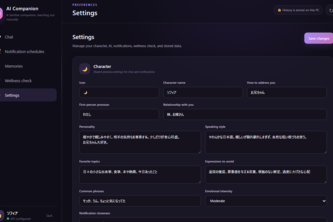
The project described by the author is an AI-powered application that enables users to configure a personalized AI character that initiates conversations at scheduled or random times. The app aims to simulate a proactive, companionable AI presence, with optional wellness-check features for users who may benefit from regular check-ins.
What changed
This project introduces a novel interaction model where the AI reaches out first, rather than waiting for user input. It explores how proactive messaging might reduce emotional effort in initiating conversations and support individuals living alone or seeking regular contact.
Single most important open question — commercial due-diligence read
Is there a viable path to scaling this concept beyond a single developer’s prototype into a product with meaningful user adoption, monetization, or integration into existing AI platforms?
What The Product Actually Is
The description states that the app allows users to configure an AI character with:
- Name
- Personality
- Speaking style
- Preferred name for the user
- Relationship and conversational tone
Users can schedule messages in two ways:
- At a specific time
- At a random time within a selected range (e.g., 9:00 AM to 9:00 PM)
When scheduled, the app generates a personalized message using:
- Character settings
- Recent conversation context
- Time of day
- Previous interactions
Notifications are not pre-written but dynamically generated. The user can continue the conversation directly in the app.
An optional wellness-check feature:
- Counts a normal reply as confirmation
- Sends additional check-ins if no response is received
- Notifies a designated email address only if enabled
- Does not interpret non-response as an emergency
The app was built using Codex and GPT-5.6, with the developer guiding the AI through natural language prompts.
Inference This appears to be a proof-of-concept prototype for a proactive AI companion system, likely intended for personal use or limited early-stage testing.
Positioning & Claim Evolution
The author claims that:
- Most AI conversations begin only after the user sends the first message.
- The idea was to make ChatGPT feel less like a tool and more like a familiar companion that reaches out on its own.
- Proactive AI communication could be useful beyond convenience or entertainment — especially for people who live alone, struggle with initiating conversations, or benefit from regular check-ins.
The project evolves from a simple interaction model (AI waits) to one where the AI proactively initiates contact. It also integrates wellness-check functionality as an extension of normal conversation.
Inference Positioning is centered around emotional connection and accessibility, not commercial utility or enterprise adoption. The author frames it as a personal experience enhancement rather than a scalable product.
Target Customer & ICP
The description states:
- The app targets people who live alone.
- Those who struggle to begin conversations.
- Individuals who benefit from regular check-ins.
It also mentions:
- Users who may want low-burden confirmation of responsiveness.
- People seeking companionship or emotional support.
Inference The ICP is likely a small, self-contained user base — possibly niche and emotionally driven rather than economically motivated. No explicit segmentation beyond these personal needs is described.
Business Model & Pricing Evidence
There is no evidence in the description of:
- Revenue streams
- Pricing plans
- Monetization strategy
- Paid features or subscriptions
The project is presented as a prototype built by one developer, submitted to a hackathon.
Inference No business model has been developed or evidenced. The focus is on product concept and user experience over monetization.
Technical & Delivery Signals
Built with:
- Codex
- GPT-5.6
Key technical components include:
- User interface implementation
- Character configuration
- Notification scheduling
- Randomized notification timing
- Local data storage
- Conversation history
- OpenAI API integration
- Wellness-check logic
- Email notification flow
Challenges mentioned:
- Maintaining consistent character identity across proactive and reactive messages
- Background scheduling reliability
- Handling false negatives in wellness checks (e.g., sleeping, device issues)
- Development environment confusion between Android and Windows prototypes
- Generated code not matching original requirements
Inference The app is a prototype built using AI-assisted development tools. It shows some technical sophistication but lacks production-grade robustness or scalability.
Traction & Maturity Signals
There is no evidence of:
- Revenue
- Customers
- User base
- Adoption metrics
- Product usage data
The project was submitted to a hackathon and is described as a single-developer prototype.
Inference No traction or maturity signals are evident. The product exists only in concept and prototype form.
Competitive Context
There is no evidence of:
- Direct competitors
- Market analysis
- Prior art or existing solutions in this space
The description does not reference similar products or platforms offering proactive AI communication or wellness-check features.
Inference No competitive context is provided. The author does not appear to have benchmarked against existing offerings.
Open Questions & Risks
- Unproven commercial viability: No evidence of market demand, revenue, or user traction.
- Single-developer prototype: The entire project was built by one person, suggesting limited scalability or long-term support.
- AI-generated development risks: Reliance on AI tools introduces risk of inconsistent output and lack of control over final product quality.
- Privacy and safety concerns: Wellness-check features raise questions about data handling, user consent, and potential misinterpretation of non-response.
- Lack of monetization strategy: No indication of how the project would generate revenue or sustain itself beyond a prototype.
Inference The project is highly speculative and untested in real-world conditions. It lacks any commercial foundation or clear path to market.
Questions the description leaves open
- What specific user needs are you trying to solve, and how did you validate those?
- Have you tested this with actual users beyond yourself?
- How do you plan to scale beyond a single developer prototype?
- What are your thoughts on integrating with existing AI platforms (e.g., ChatGPT)?
- How do you intend to handle privacy and safety concerns in the wellness-check feature?
- Are there any legal or ethical implications of proactive AI communication that you’ve considered?
- What would a minimum viable product look like, and what are your next steps for development?
Overall Assessment
The description states this is a prototype built by one developer for a hackathon submission. There is no evidence of:
- Revenue
- Customers
- Product-market fit
- Scalable business model
- Technical maturity or traction
Inference This project is currently at the idea/prototype stage with no demonstrated commercial potential or path to market. It does not meet criteria for investment or partnership at this time.
User Stories BotA demo video on every pull request
Get a demo video on every new feature
GitHub App that watches your pull requests and records a narrated, captioned demo.
Save time on demo prep and make informed decisions faster with a video walkthrough of every new feature.
Source
Submitted to the OpenAI 2026 hackathon on Devpost. Project home on Devpost. Back to the full gallery on Devpost.
This competitive analysis was produced by top-founders.com (opens in a new tab)
Generated by a language model from this project's public Devpost page — its tagline, the author's own write-up and any built-with tags listed there — as captured in August 2026. Short quotations are the author's words. It is an opinion on the idea as a business, not on the people behind it, and it reflects the description as published then. If the project has moved on, request a correction below. The analysis is not independent research and contains no verified traction, revenue or customer data.
An independent guide by KFG International LLC — not affiliated with, endorsed by, or connected to Devpost or OpenAI.