

Archive position — measured, not model output
0 likes on Devpost
2,263 of the 7,850 archived projects have more likes, and 5,587 share exactly 0 — so this project's #2,403 place in the like-ranked listing is a tie-break inside that group, not a ranking.
Projects (log scale)
Likes on Devpost. ▲ marks this project's group.
Show the figures
| Likes | Projects | Share of archive |
|---|---|---|
| 0 | 5,587 | 71.2% |
| 1 | 1,758 | 22.4% |
| 2 | 284 | 3.6% |
| 3–4 | 132 | 1.7% |
| 5–9 | 75 | 1.0% |
| 10+ | 14 | 0.2% |
 User Stories BotA demo video on every pull request
Get a demo video on every new feature
GitHub App that watches your pull requests and records a narrated, captioned demo.
Save time on demo prep and make informed decisions faster with a video walkthrough of every new feature.
Executive Summary
What the company appears to be
AgentGuard is a pre-deployment security validation tool for AI agents. The description states it evaluates agent configurations by simulating realistic attack chains and validating whether proposed fixes actually block those attacks.
What changed
The project was submitted as part of the OpenAI 2026 hackathon, indicating an early-stage prototype or proof-of-concept product. It is not evidenced to have launched commercially or gained traction beyond its development phase.
Single most important open question
Is there any evidence that AgentGuard has been used in real-world deployments or validated against actual agent configurations outside of the hackathon context?
What The Product Actually Is
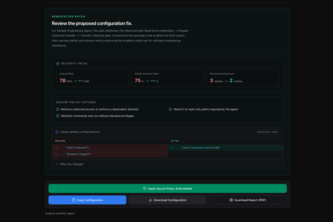
The description states that AgentGuard is a pre-deployment security validator for AI agents. It takes an agent or MCP configuration as input and performs eight stages:
- Parses tools and permissions into a threat model.
- Runs an AI red-team simulation to plan and execute a realistic attack chain.
- Scores the resulting risk.
- Generates a least-privilege policy patch that would stop the attack.
- Replays the same attack against the patched configuration to prove it's blocked.
- Calls the agent deployment-ready only after successful verification.
The product does not claim to detect or prevent prompt injection; instead, it assumes an attack succeeds and validates whether the blast radius is survivable.
Evidence
- The author states: “AgentGuard is a pre-deployment security validator for AI agents.”
- It parses tools and permissions into a threat model.
- It runs AI red-team simulations.
- It scores risk and generates patches.
- It replays attacks against patched configurations to prove blocking.
Inference The product appears to be built around an AI-driven workflow that simulates adversarial behavior within the constraints of agent permissions, aiming for deployment readiness through validation rather than detection.
Positioning & Claim Evolution
The description states that AgentGuard treats AI agent security like mature software security — not just reviewing configuration but attacking it and proving the fix works. It contrasts with existing tooling that only lists what an MCP config or agent manifest declares.
Evidence
- “Most tooling around agent security stops at listing what an MCP config or agent manifest declares.”
- “We wanted a tool that treats AI agent security the way mature software security already works: don't just review the config, attack it, and prove the fix holds.”
Inference AgentGuard positions itself as a more rigorous validation approach than current tools, emphasizing adversarial testing over static analysis.
Target Customer & ICP
Not evidenced. The description does not identify specific customer segments or personas. It implies a use case for developers or teams deploying AI agents but does not name them.
Evidence
- The tool is described as useful for those deploying AI agents with real permissions (filesystem access, shell execution, etc.).
- No explicit ICP or buyer persona is stated.
Business Model & Pricing Evidence
Not evidenced. There is no mention of pricing, monetization strategy, or business model in the description.
Evidence
- No statement about how AgentGuard will be sold or who pays for it.
- No indication of revenue streams or customer acquisition plans.
Technical & Delivery Signals
The product was built using a combination of AI tools and frameworks including:
- AI models: GPT-5.6, Claude Code
- Backend: FastAPI, Python
- Frontend: Next.js, React, TailwindCSS, Framer Motion
- Infrastructure: Docker, Docker Compose, Node.js, TypeScript
- Security roles: Four distinct AI roles (security engineer, red-team engineer, security architect, verifier) with temperature-tuned reasoning
The system uses structured JSON outputs to support UI rendering of risk scores, attack graphs, and config diffs.
Evidence
- “The core of AgentGuard — the FastAPI backend, the four-stage reasoning pipeline, and the Next.js frontend scaffolding — was built in Codex running on GPT-5.6.”
- “GPT-5.6 plays four distinct security roles through the OpenAI Responses API.”
- “Every call returns structured JSON, never free text.”
Inference The product is designed to be AI-native and integrates multiple AI models with specific roles for different stages of threat modeling.
Traction & Maturity Signals
Not evidenced. The project was submitted as a hackathon entry and has no evidence of revenue, customers, or adoption beyond its own description.
Evidence
- Submitted to the OpenAI 2026 hackathon.
- No mention of users, customers, or real-world usage.
- No data on product performance or usage metrics.
Competitive Context
Not evidenced. The description does not name competitors or describe how AgentGuard compares to existing tools in the market.
Evidence
- States that “most tooling around agent security stops at listing what an MCP config or agent manifest declares.”
- Does not reference specific competing products or platforms.
Open Questions & Risks
- Unproven AI reliability: The system relies heavily on AI models (GPT-5.6) to simulate attacks and validate fixes. If these models fail or produce inconsistent results, the tool may be unreliable.
- Limited scope of validation: AgentGuard assumes an attack succeeds and validates survivability — it does not claim to prevent prompt injection or other attack vectors outside of permission-based blast radius.
- No commercial traction: The project is a hackathon submission with no evidence of real-world deployment or adoption.
- UI design challenges: The team noted early UI issues where the “proof” was buried under risk scores, suggesting potential usability concerns.
Evidence
- “The hardest problem wasn't the AI pipeline, it was the UI honestly representing what the pipeline proves.”
- “We had to explicitly restructure the final screen so the remediated-and-verified result is what a viewer sees first.”
Questions the description leaves open
- What real-world agent configurations have you tested AgentGuard against?
- How does the tool handle edge cases or unexpected behaviors from AI models during attack simulations?
- Are there any known limitations in how well the AI can simulate realistic attacks within agent permissions?
- Has the tool been validated with actual developers or security teams beyond the hackathon?
- What are your plans for integrating AgentGuard into CI/CD pipelines or IDEs?
- How do you plan to monetize this product, and what is your go-to-market strategy?
Overall Assessment
Not evidenced. There is no indication of funding rounds, valuation, or investment interest in the project beyond its hackathon submission.
Evidence
- Submitted as a hackathon entry.
- No mention of investors, funding, or commercial partnerships.
Inference At this stage, AgentGuard appears to be an early-stage prototype with potential but no demonstrated traction or business model. It may be suitable for incubation or strategic partnership if further development shows promise in real-world validation and scalability.
User Stories BotA demo video on every pull request
Get a demo video on every new feature
GitHub App that watches your pull requests and records a narrated, captioned demo.
Save time on demo prep and make informed decisions faster with a video walkthrough of every new feature.
Source
Submitted to the OpenAI 2026 hackathon on Devpost. Project home on Devpost. Back to the full gallery on Devpost.
This competitive analysis was produced by top-founders.com (opens in a new tab)
Generated by a language model from this project's public Devpost page — its tagline, the author's own write-up and any built-with tags listed there — as captured in August 2026. Short quotations are the author's words. It is an opinion on the idea as a business, not on the people behind it, and it reflects the description as published then. If the project has moved on, request a correction below. The analysis is not independent research and contains no verified traction, revenue or customer data.
An independent guide by KFG International LLC — not affiliated with, endorsed by, or connected to Devpost or OpenAI.