

Archive position — measured, not model output
0 likes on Devpost
2,263 of the 7,850 archived projects have more likes, and 5,587 share exactly 0 — so this project's #2,398 place in the like-ranked listing is a tie-break inside that group, not a ranking.
Projects (log scale)
Likes on Devpost. ▲ marks this project's group.
Show the figures
| Likes | Projects | Share of archive |
|---|---|---|
| 0 | 5,587 | 71.2% |
| 1 | 1,758 | 22.4% |
| 2 | 284 | 3.6% |
| 3–4 | 132 | 1.7% |
| 5–9 | 75 | 1.0% |
| 10+ | 14 | 0.2% |
 User Stories BotA demo video on every pull request
Get a demo video on every new feature
GitHub App that watches your pull requests and records a narrated, captioned demo.
Save time on demo prep and make informed decisions faster with a video walkthrough of every new feature.
Executive Summary
What the company appears to be
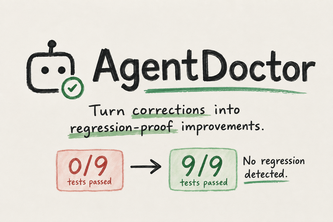
AgentDoctor Correction Loop is a self-reported tool designed for small AI product teams to convert human corrections of agent behavior into targeted evaluations, repeated regression tests, and bounded repair goals. It aims to improve agent reliability by turning production failures into reusable test assets.
What changed
The project description indicates that the team built a correction-driven evaluation loop rather than a static prompt review tool. It introduces a workflow where one human correction becomes a set of frozen evaluation cases, repeated regression tests, and a narrowly scoped repair task.
Single most important open question — the commercial due-diligence read
Is there evidence of real-world usage or adoption by AI teams? The description is entirely self-reported and lacks any data on revenue, customers, product usage, or traction beyond a demo.
What The Product Actually Is
The description states that AgentDoctor Correction Loop helps small AI teams determine whether an agent fix works without breaking existing behavior. It captures failures and human corrections, diagnoses the failure using GPT-5.6, generates targeted evaluations, runs repeated regression tests, produces an evidence-based assessment, and creates a bounded Codex repair goal.
Inference The system appears to be a prototype or demo focused on QA-agent scenarios, with no automatic repository editing capability in its current version.
Positioning & Claim Evolution
The description states that AgentDoctor turns one human correction into targeted evals, repeated regression tests, and a bounded Codex repair goal. It positions itself as a way for small AI teams to verify fixes without breaking existing behavior.
Inference It is positioned as a reliability tool for AI agents, not a general-purpose LLM evaluation platform or prompt engineering tool.
Target Customer & ICP
The description states that AgentDoctor targets “small AI product teams.” It also notes that the current public demo intentionally uses a narrow QA-agent scenario so that every conclusion can be inspected.
Inference The target customer is likely small to mid-sized AI product teams working on agent-based systems, particularly those in early-stage development or testing phases.
Business Model & Pricing Evidence
Not evidenced. The description does not mention any pricing model, monetization strategy, or business model.
Technical & Delivery Signals
The system uses GPT-5.6 for diagnosis and is built with technologies including Next.js, React, Node.js, Tailwind, TypeScript, Vercel, OpenAI, and Codex. It generates frozen evaluation cases and runs repeated tests against baseline and candidate versions.
Inference It appears to be a prototype or demo tool focused on QA-agent workflows, not a production-ready SaaS offering.
Traction & Maturity Signals
Not evidenced. There is no mention of revenue, customers, user base, or product adoption beyond the demo.
Competitive Context
Not evidenced. The description does not reference competitors or market positioning in relation to other tools for AI agent reliability or testing.
Open Questions & Risks
- No evidence of real-world usage or traction: The entire description is self-reported and lacks any data on adoption.
- Demo-only scope: The current version only demonstrates the evaluation and regression loop, not full automation or repository editing.
- Unproven scalability: The system is built around a narrow QA-agent scenario; no indication it scales beyond that.
- No commercial viability signal: No pricing, monetization, or business model described.
Questions the description leaves open
- What real-world feedback or use cases drove the development of this tool?
- Has the system been tested with actual AI agents in production environments?
- Are there any plans to integrate with existing CI/CD or repository systems?
- How does the team plan to scale beyond the current demo scenario?
- What is the long-term vision for monetization and product development?
Overall Assessment
Not evidenced. The description provides no information on valuation, funding rounds, or investment history. It also lacks any indication of commercial traction or market readiness.
User Stories BotA demo video on every pull request
Get a demo video on every new feature
GitHub App that watches your pull requests and records a narrated, captioned demo.
Save time on demo prep and make informed decisions faster with a video walkthrough of every new feature.
Source
Submitted to the OpenAI 2026 hackathon on Devpost. Project home on Devpost. Back to the full gallery on Devpost.
This competitive analysis was produced by top-founders.com (opens in a new tab)
Generated by a language model from this project's public Devpost page — its tagline, the author's own write-up and any built-with tags listed there — as captured in August 2026. Short quotations are the author's words. It is an opinion on the idea as a business, not on the people behind it, and it reflects the description as published then. If the project has moved on, request a correction below. The analysis is not independent research and contains no verified traction, revenue or customer data.
An independent guide by KFG International LLC — not affiliated with, endorsed by, or connected to Devpost or OpenAI.