

Archive position — measured, not model output
0 likes on Devpost
2,263 of the 7,850 archived projects have more likes, and 5,587 share exactly 0 — so this project's #7,536 place in the like-ranked listing is a tie-break inside that group, not a ranking.
Projects (log scale)
Likes on Devpost. ▲ marks this project's group.
Show the figures
| Likes | Projects | Share of archive |
|---|---|---|
| 0 | 5,587 | 71.2% |
| 1 | 1,758 | 22.4% |
| 2 | 284 | 3.6% |
| 3–4 | 132 | 1.7% |
| 5–9 | 75 | 1.0% |
| 10+ | 14 | 0.2% |
 User Stories BotA demo video on every pull request
Get a demo video on every new feature
GitHub App that watches your pull requests and records a narrated, captioned demo.
Save time on demo prep and make informed decisions faster with a video walkthrough of every new feature.
Executive Summary
What the company appears to be
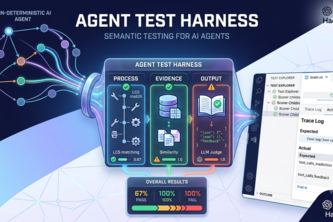
Vibe Check is a developer tool for testing LangGraph agents, built as a Python CLI and VS Code extension. The author states it enables semantic testing of agent behavior by evaluating process (tool usage), evidence (grounding), and output (answer quality). It supports test definition in .agent-test.yaml files and integrates with VS Code’s Test Explorer.
What changed
The project was submitted to the OpenAI 2026 hackathon. The author describes building it from scratch, with no external funding or traction claimed.
Single most important open question
Is there evidence of developer adoption or usage beyond the single-person build and demo?
What The Product Actually Is
The description states that Vibe Check is a semantic testing framework for LangGraph agents, built as a Python CLI and VS Code extension. It allows developers to define tests in .agent-test.yaml files with:
- Task
- Expected tool behavior
- Required evidence sources
- Output rubric
- Optional reliability threshold
Each test run is scored independently on:
- Process (tool calls, order, forbidden tools)
- Evidence (grounding, required sources)
- Output (natural-language rubric)
Results appear in the CLI and VS Code Test Explorer with scorer-level results, visual summaries, and one-click traces.
Evidence
- Author states: “Vibe Check is a semantic testing framework for LangGraph agents.”
- Author states: “Developers define tests in .agent-test.yaml files...”
- Author states: “The Python side loads YAML test suites, runs LangGraph agents with callback tracing...”
- Author states: “The VS Code extension consumes the JSON report and turns it into native tests...”
Inference The tool is designed to be used by developers working with LangGraph agents in a local development environment.
Positioning & Claim Evolution
The author positions Vibe Check as a developer tool that treats agent behavior as a testable contract, not just answer correctness. It emphasizes:
- Testing process, evidence, and output separately
- Making failures actionable through traceability
- Supporting repeated runs for reliability
- Integrating into existing developer workflows (VS Code)
The author claims it addresses a gap in current testing practices — where most tests only check final answers, ignoring agent behavior.
Evidence
- Author states: “Most tests check whether the final answer looks correct. But agents can produce convincing answers while skipping the retrieval, policy, or safety step that should have justified the answer.”
- Author states: “I wanted a developer tool that treats agent behavior as a testable contract...”
- Author states: “The project turns a subtle agent reliability problem into something concrete, visual, and fixable.”
Inference This is a niche tool for developers working with LangGraph agents in Python environments. It is positioned as a solution to a specific problem in AI agent testing.
Target Customer & ICP
The author states that Vibe Check targets developers working with LangGraph agents, particularly those building or debugging AI agents in Python and using VS Code.
Evidence
- Author states: “Vibe Check is a semantic testing framework for LangGraph agents.”
- Author states: “I built Vibe Check as a Python CLI and a VS Code extension.”
- Author states: “Developers can open the exact tool trace in one click.”
Inference The ICP is likely Python developers using LangGraph, especially those working on agent-based systems where process, evidence, and output reliability matter.
Business Model & Pricing Evidence
Not evidenced. The author does not describe any pricing model or business model.
Evidence
- No mention of monetization, pricing tiers, or commercial use cases.
- No indication of paid features or SaaS offerings.
Technical & Delivery Signals
The tool is built using:
- Python CLI
- VS Code extension
- LangChain, LangGraph, Pydantic, Pytest, OpenAI, Groq, JSON, YAML, TypeScript, Streamlit
It supports:
- YAML test suite definition
- Tool call tracing
- JSON reporting
- Integration with VS Code Test Explorer
- One-click trace view
- Repeated execution for pass-rate thresholds
Evidence
- Author states: “I built Vibe Check as a Python CLI and a VS Code extension.”
- Author states: “The Python side loads YAML test suites, runs LangGraph agents with callback tracing...”
- Author states: “The VS Code extension consumes the JSON report and turns it into native tests...”
Inference It is a lightweight developer tool for local testing, not a cloud-based or SaaS offering.
Traction & Maturity Signals
Not evidenced. The author does not describe any customers, usage metrics, revenue, or product adoption beyond the single-person build and demo.
Evidence
- Author states: “Team size: 1”
- Author states: “To demonstrate the product, I built a fictional Support Desk refund agent.”
- No mention of users, feedback, or real-world deployment.
Competitive Context
Not evidenced. The author does not describe existing tools or competitors in the space.
Evidence
- No reference to similar tools or frameworks for testing AI agents.
- No comparison with other developer tooling or LLM evaluation platforms.
Open Questions & Risks
- Single-person build: The project is built by one person, which raises questions about scalability and long-term maintenance.
- No traction or adoption: No evidence of real-world usage or customer feedback.
- Limited scope: It only supports LangGraph agents and Python environments.
- No monetization strategy: No indication of how the tool will be commercialized or sustained.
Evidence
- Author states: “Team size: 1”
- Author states: “The project was submitted to the OpenAI 2026 hackathon.”
- No mention of customers, revenue, or product-market fit.
Questions the description leaves open
- What is your plan for expanding beyond LangGraph and Python?
- Have you received any feedback from developers using this tool in real projects?
- How do you intend to monetize or sustain the tool long-term?
- Are there plans to support CI/CD integrations or other developer workflows?
- What are the key assumptions about developer behavior that underpin your design choices?
Overall Assessment
Not evidenced. The author does not describe any funding, investment interest, or partnership discussions.
Evidence
- No mention of funding rounds, investors, or partnerships.
- No indication of commercial traction or market validation.
Inference This is a hackathon project with no evidence of commercial viability or investor interest at this time. It may be early-stage and exploratory in nature.
User Stories BotA demo video on every pull request
Get a demo video on every new feature
GitHub App that watches your pull requests and records a narrated, captioned demo.
Save time on demo prep and make informed decisions faster with a video walkthrough of every new feature.
Source
Submitted to the OpenAI 2026 hackathon on Devpost. Project home on Devpost. Back to the full gallery on Devpost.
This competitive analysis was produced by top-founders.com (opens in a new tab)
Generated by a language model from this project's public Devpost page — its tagline, the author's own write-up and any built-with tags listed there — as captured in August 2026. Short quotations are the author's words. It is an opinion on the idea as a business, not on the people behind it, and it reflects the description as published then. If the project has moved on, request a correction below. The analysis is not independent research and contains no verified traction, revenue or customer data.
An independent guide by KFG International LLC — not affiliated with, endorsed by, or connected to Devpost or OpenAI.