

Archive position — measured, not model output
0 likes on Devpost
2,263 of the 7,850 archived projects have more likes, and 5,587 share exactly 0 — so this project's #7,841 place in the like-ranked listing is a tie-break inside that group, not a ranking.
Projects (log scale)
Likes on Devpost. ▲ marks this project's group.
Show the figures
| Likes | Projects | Share of archive |
|---|---|---|
| 0 | 5,587 | 71.2% |
| 1 | 1,758 | 22.4% |
| 2 | 284 | 3.6% |
| 3–4 | 132 | 1.7% |
| 5–9 | 75 | 1.0% |
| 10+ | 14 | 0.2% |
 User Stories BotA demo video on every pull request
Get a demo video on every new feature
GitHub App that watches your pull requests and records a narrated, captioned demo.
Save time on demo prep and make informed decisions faster with a video walkthrough of every new feature.
Executive Summary
The description states that "数据分析agent" (Data Analysis Agent) is a tool designed to automatically process complex PDF documents, scanned images, and mixed text-image content within enterprises. It claims to deliver good results with minimal cost. The project was submitted by one individual, 李 波, to the OpenAI 2026 hackathon on Devpost.
The author describes it as an agent built using GPT, Langchain, Langgraph, and OpenAI technologies. No revenue, customers, or traction are evidenced. The positioning is unclear beyond a self-reported capability to automate document processing tasks.
The single most important open question
What specific business problem does this tool solve for enterprises, and how does it differ from existing tools in the market?
What The Product Actually Is
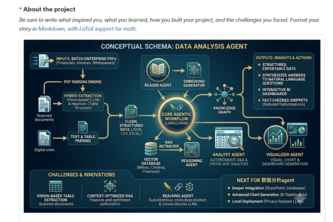
The description states that the product is an "agent" that handles complex PDF text, scanned documents, and mixed text-image content. It is described as being built with GPT, Langchain, Langgraph, and OpenAI technologies.
Inference Based on the technology stack and the nature of the problem described, it likely performs document parsing, extraction, and potentially summarization or classification tasks using LLMs.
Not evidenced The exact functionality, output format, or use case beyond general document processing is not detailed.
Positioning & Claim Evolution
The tagline states: “一个自动处理企业内部复杂PDF文本、扫描件、图文的agent,可以用最小成本拿到比较好的效果” — which translates to: "An agent that automatically processes complex PDF text, scanned documents, and mixed text-image content within enterprises, with minimal cost and good results."
Claim
The product positions itself as a low-cost solution for enterprise document processing.
Not evidenced There is no evidence of prior positioning or evolution in claims. The description only includes the current self-stated value proposition.
Target Customer & ICP
The description states that the agent is intended for use "within enterprises" and handles "complex PDF text, scanned documents, and mixed text-image content."
Inference The target customer appears to be enterprise users who need automated processing of unstructured document data.
Not evidenced No specific industry, department, or persona is identified. No evidence of customer segmentation or ideal customer profile (ICP) is provided.
Business Model & Pricing Evidence
The description does not state anything about a business model or pricing structure.
Not evidenced There is no information on how the product would be monetized, whether it's sold as SaaS, a one-time tool, or otherwise.
Technical & Delivery Signals
The author states that the agent was built using:
- GPT
- Langchain
- Langgraph
- OpenAI
Inference The project likely uses LLM orchestration and prompt engineering techniques to process documents.
Not evidenced No evidence of delivery mechanism, scalability, or deployment method is provided. No mention of API access, UI, or integration capabilities.
Traction & Maturity Signals
The description states that the project was submitted to the OpenAI 2026 hackathon on Devpost and was built by one person, 李 波.
Not evidenced There is no evidence of any traction, revenue, customer adoption, or product maturity beyond a hackathon submission. No data on usage, feedback, or iteration history is provided.
Competitive Context
The description does not mention any competitors or how this tool compares to existing solutions in the market.
Not evidenced No competitive analysis, differentiation, or market positioning relative to other document processing tools is included.
Open Questions & Risks
- Single-founder project: The product was built by one person, raising questions about scalability and long-term maintenance.
- No traction or revenue: The project has no evidence of real-world usage or monetization.
- Unverified claims: All claims are self-reported without external validation.
- Limited scope: The description is sparse and lacks detail on functionality, output, or use cases.
Questions the description leaves open
- What specific document processing tasks does the agent perform, and how does it handle ambiguity in scanned or low-quality documents?
- How does this tool differ from existing solutions like Adobe Scan, DocuSign, or other LLM-based document processors?
- Is there a plan to monetize this tool, and if so, what is the business model?
- What are the technical limitations of the current implementation, and how might they scale?
- How does the agent handle enterprise-level security and data privacy concerns?
Overall Assessment
Not evidenced There is no evidence to support an investment or partnership decision.
The project is described as a hackathon submission by one individual with no demonstrated traction, revenue, or customer base. The description lacks sufficient detail to assess commercial viability or market fit.
Confidence level Low — based on minimal self-reported information and absence of any external validation or evidence of product-market fit.
User Stories BotA demo video on every pull request
Get a demo video on every new feature
GitHub App that watches your pull requests and records a narrated, captioned demo.
Save time on demo prep and make informed decisions faster with a video walkthrough of every new feature.
Source
Submitted to the OpenAI 2026 hackathon on Devpost. Project home on Devpost. Back to the full gallery on Devpost.
This competitive analysis was produced by top-founders.com (opens in a new tab)
Generated by a language model from this project's public Devpost page — its tagline and any built-with tags listed there, since the author published no write-up — as captured in August 2026. Short quotations are the author's words. It is an opinion on the idea as a business, not on the people behind it, and it reflects the description as published then. If the project has moved on, request a correction below. The analysis is not independent research and contains no verified traction, revenue or customer data.
An independent guide by KFG International LLC — not affiliated with, endorsed by, or connected to Devpost or OpenAI.