

Archive position — measured, not model output
0 likes on Devpost
2,263 of the 7,850 archived projects have more likes, and 5,587 share exactly 0 — so this project's #2,370 place in the like-ranked listing is a tie-break inside that group, not a ranking.
Projects (log scale)
Likes on Devpost. ▲ marks this project's group.
Show the figures
| Likes | Projects | Share of archive |
|---|---|---|
| 0 | 5,587 | 71.2% |
| 1 | 1,758 | 22.4% |
| 2 | 284 | 3.6% |
| 3–4 | 132 | 1.7% |
| 5–9 | 75 | 1.0% |
| 10+ | 14 | 0.2% |
 User Stories BotA demo video on every pull request
Get a demo video on every new feature
GitHub App that watches your pull requests and records a narrated, captioned demo.
Save time on demo prep and make informed decisions faster with a video walkthrough of every new feature.
Executive Summary
AgencyOS AI is a self-reported AI-powered tool designed to automate the creation of client project workspaces from a single client brief. The author states it uses GPT-5.6 and OpenAI Responses API, with a frontend built in React, TypeScript, Vite, and backend integration via Supabase Edge Functions. It is described as transforming a plain-language input into structured outputs including proposals, timelines, tasks, onboarding checklists, welcome emails, and invoices.
The author claims the tool was developed for small agencies or service businesses to reduce manual work in project setup. The system is said to support project persistence, schema validation, and error handling. It is currently a single-person project, submitted to the OpenAI 2026 hackathon.
Key open question: Is there evidence of traction, revenue, or customer adoption beyond the author’s self-report?
What The Product Actually Is
The description states that AgencyOS AI allows users to input:
- Client name
- Project name
- Project brief
From this, it generates a structured project blueprint including:
- Professional proposal
- Project summary and objectives
- Scope and deliverables
- Delivery phases and milestones
- Internal tasks with priorities and suggested owners
- Client onboarding checklist
- Welcome email
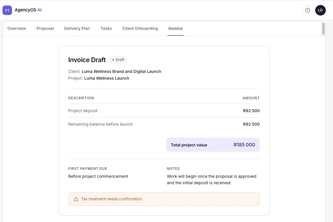
- Budget, deposit and invoice draft
- Risks, assumptions and confirmation questions
The system is said to store each project independently in a dashboard for future editing.
Inference: The tool appears to be an AI-powered workflow automation platform aimed at service-based businesses. It is not a general-purpose AI assistant but a domain-specific tool for project creation and management.
Positioning & Claim Evolution
The author positions AgencyOS AI as a solution for small agencies and service businesses that spend hours manually creating client project documents.
It is described as turning one client brief into a complete, ready-to-run project workspace in minutes, using GPT-5.6.
The product is said to be built with self-reported technical stack including React, Supabase Edge Functions, OpenAI API, and Zod validation.
Claim: The tool reduces manual work, delays, inconsistencies, and missed details in client onboarding.
Inference: This is a productized AI workflow automation tool, not an AI assistant or general-purpose content generator. It targets a specific use case within creative or consulting agencies.
Target Customer & ICP
The author states that small agencies and service businesses are the primary users of AgencyOS AI.
They claim these businesses often receive client briefs and then spend hours manually creating:
- Proposals
- Delivery plans
- Task lists
- Onboarding checklists
- Welcome emails
- Invoice drafts
Inference: The target customer is likely small to mid-sized agencies, possibly in creative, marketing, or consulting sectors.
Not evidenced: No specific industry, size of agency, or customer segment is named. No evidence of actual customers or user personas.
Business Model & Pricing Evidence
The description does not include any information about:
- Revenue model
- Pricing structure
- Monetization strategy
- Customer acquisition costs
- Unit economics
Inference: The author mentions a future roadmap that includes user authentication, cloud storage, team collaboration, and billing, suggesting a potential move toward a SaaS business model.
Not evidenced: No pricing, subscription tiers, or monetization details are provided.
Technical & Delivery Signals
The product is built with:
- Frontend: React, TypeScript, Vite
- Backend: Supabase Edge Functions
- AI: GPT-5.6 via OpenAI Responses API
- Validation: Zod schema validation
- Security: OpenAI API key remains server-side
Inference: The tool uses a server-side API integration, with structured output generation and schema validation to ensure consistency.
The author mentions using Codex for development, debugging, and improving the product.
Not evidenced: No details on infrastructure scaling, deployment strategy, or performance metrics.
Traction & Maturity Signals
The project is described as a single-person hackathon submission, built for the OpenAI 2026 hackathon.
It is said to have undergone:
- Bug fixes (e.g., multi-project persistence)
- Validation improvements
- Language filtering and retry logic
Inference: The tool is in an early stage of development, likely a prototype or MVP.
Not evidenced: No data on:
- Users
- Adoption
- Revenue
- Customer feedback
- Product usage metrics
Competitive Context
The author does not mention any competitors. However, based on the described functionality, it overlaps with:
- Proposal automation tools (e.g., PandaDoc, DocuSign)
- Project management platforms (e.g., Asana, Notion, Monday.com)
- AI content generation tools (e.g., Jasper, Copy.ai)
Inference: The tool is positioned to fill a gap in project onboarding automation, especially for small agencies.
Not evidenced: No competitive analysis, pricing comparison, or differentiation strategy provided.
Open Questions & Risks
- No traction evidence: The product is described as a hackathon submission with no customer base.
- Unverified AI model: GPT-5.6 is not a confirmed model; the author may be using an internal or unreleased version.
- Single-person development: No team, no external validation, no product-market fit evidence.
- Lack of monetization strategy: No pricing, billing, or revenue model described.
- Unproven scalability: The tool is said to support multiple projects but lacks details on persistence architecture or performance.
Questions the description leaves open
- What is the actual AI model being used? Is GPT-5.6 a real model or an internal naming convention?
- How many users or agencies have tested this in practice?
- What are the current limitations of the system, and how does it handle edge cases?
- Are there any plans for user authentication, team collaboration, or multi-tenancy?
- What is the roadmap for monetization and scaling beyond a single-person hackathon project?
Overall Assessment
Not evidenced: No financials, traction, or customer data are provided.
Inference: The product is in an early prototype stage, likely a hackathon MVP. It has potential to evolve into a SaaS product for agencies but lacks evidence of market demand or business viability at this time.
Confidence level: Low — based on self-reported, unverified information only.
Assessment: Not ready for investment or partnership without further evidence of traction, customer validation, or monetization strategy.
User Stories BotA demo video on every pull request
Get a demo video on every new feature
GitHub App that watches your pull requests and records a narrated, captioned demo.
Save time on demo prep and make informed decisions faster with a video walkthrough of every new feature.
Source
Submitted to the OpenAI 2026 hackathon on Devpost. Project home on Devpost. Back to the full gallery on Devpost.
This competitive analysis was produced by top-founders.com (opens in a new tab)
Generated by a language model from this project's public Devpost page — its tagline, the author's own write-up and any built-with tags listed there — as captured in August 2026. Short quotations are the author's words. It is an opinion on the idea as a business, not on the people behind it, and it reflects the description as published then. If the project has moved on, request a correction below. The analysis is not independent research and contains no verified traction, revenue or customer data.
An independent guide by KFG International LLC — not affiliated with, endorsed by, or connected to Devpost or OpenAI.