

Archive position — measured, not model output
0 likes on Devpost
2,263 of the 7,850 archived projects have more likes, and 5,587 share exactly 0 — so this project's #2,366 place in the like-ranked listing is a tie-break inside that group, not a ranking.
Projects (log scale)
Likes on Devpost. ▲ marks this project's group.
Show the figures
| Likes | Projects | Share of archive |
|---|---|---|
| 0 | 5,587 | 71.2% |
| 1 | 1,758 | 22.4% |
| 2 | 284 | 3.6% |
| 3–4 | 132 | 1.7% |
| 5–9 | 75 | 1.0% |
| 10+ | 14 | 0.2% |
 User Stories BotA demo video on every pull request
Get a demo video on every new feature
GitHub App that watches your pull requests and records a narrated, captioned demo.
Save time on demo prep and make informed decisions faster with a video walkthrough of every new feature.
Executive Summary
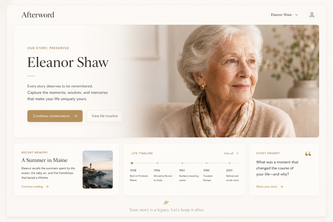
What the company appears to be: Afterword is an AI-powered biographer that uses GPT-Live to conduct continuous, full-duplex voice conversations with individuals, aiming to preserve life stories through recurring sessions. It claims to listen without interrupting, remember across sessions, and spot missing stories, ultimately turning these into books or audio memoirs.
What changed: The project is self-described as a novel approach to oral history using GPT-Live's full-duplex architecture for natural conversation flow, contrasting with traditional turn-based systems that may feel rigid or intrusive.
Single most important open question: Is there sufficient evidence of traction, revenue, or customer validation to suggest this concept has commercial viability beyond the prototype stage?
Analysis basis: This report is based solely on the self-reported description provided by the author. No external verification, archived data, or third-party sources are available.
What The Product Actually Is
The description states that Afterword is an AI biographer designed to conduct recurring voice conversations with individuals to preserve their life stories. It claims to use GPT-Live for full-duplex interaction, allowing continuous listening and responding without rigid turn-taking.
- Core functionality: Conduct long-form oral interviews using GPT-Live's full-duplex architecture.
- Key features:
- Continuous listening without forcing rigid turns
- Natural acknowledgements and gentle follow-ups
- Memory retention across sessions
- Identification of missing or unfinished stories
- Timeline-building and follow-up question generation
- Output formats: Books or audio memoirs, with original recordings preserved.
Inference: The product is described as a conversational AI tool for storytelling, not a general-purpose voice assistant or transcription service. It is positioned specifically for preserving personal narratives over time.
Positioning & Claim Evolution
The author positions Afterword as an alternative to existing services like StoryWorth, which rely on written prompts and individual responses. The claim evolution shows:
- Initial positioning: A better way to collect oral histories by removing friction from traditional formats.
- Core value proposition: An AI biographer that listens naturally, remembers context, and identifies gaps without interrupting the storyteller.
- Differentiation: Uses GPT-Live’s full-duplex architecture for more human-like conversation flow compared to turn-based systems.
Claim vs. Fact: The description states that "services like StoryWorth have shown that families are willing to invest in preserving memories," but does not provide data on actual user behavior or market demand beyond this assertion.
Target Customer & ICP
The description implies a primary customer segment:
- Primary users: Older adults (parents and grandparents) who want to preserve their life stories.
- Secondary users: Family members involved in the storytelling process.
- Use case: Preserving personal narratives through structured yet natural voice conversations.
Inference: The target is likely people interested in legacy preservation, particularly those who prefer speaking over typing. However, no explicit segmentation or persona details are provided.
Business Model & Pricing Evidence
Not evidenced.
Note: There is no mention of pricing models, monetization strategies, or revenue streams in the description.
Technical & Delivery Signals
The project is built using:
- GPT-Live (full-duplex interaction)
- Speech-to-text
- PostgreSQL (for data storage)
- TypeScript
- WebSockets
- Codex and OpenAI APIs
Key technical elements include:
- Full-duplex conversation layer using GPT-Live
- Asynchronous reasoning layer for timeline building and follow-up questions
- Delegation model separating interaction from background processing
Inference: The architecture suggests a hybrid system combining real-time voice interaction with offline analysis. However, no details on scalability, infrastructure, or deployment strategy are given.
Traction & Maturity Signals
Not evidenced.
Note: No evidence of users, customers, revenue, or product adoption is present in the description.
Competitive Context
The author references StoryWorth as a comparable service but does not name other competitors or provide competitive analysis. The project is submitted to the OpenAI 2026 hackathon, indicating it's in early development.
Inference: The competitive landscape includes services focused on preserving life stories, though no direct comparison or market positioning data is provided.
Open Questions & Risks
- Dependency on GPT-Live API access: The system depends on proprietary technology not publicly available.
- Lack of traction or validation: No evidence of users, revenue, or adoption.
- Unproven concept: The idea of an AI biographer that listens without interrupting is novel but untested in practice.
- Privacy and emotional sensitivity: Handling personal narratives raises ethical and privacy concerns not addressed in the description.
Inference: Without real-world usage or feedback, the feasibility of delivering a seamless, emotionally intelligent experience remains uncertain.
Questions the description leaves open
- What specific use cases have you identified for this tool beyond the prototype?
- How do you plan to validate the emotional and narrative quality of the AI’s responses?
- Have you tested the full-duplex interaction with real users, or is it still theoretical?
- Are there any legal or ethical considerations around collecting and preserving personal narratives?
- What are your plans for monetization or scaling beyond the hackathon prototype?
Overall Assessment
Not evidenced.
Note: There is no evidence of funding rounds, valuation, or investment interest. The project is described as a hackathon submission with no indication of commercial readiness or strategic partnerships.
User Stories BotA demo video on every pull request
Get a demo video on every new feature
GitHub App that watches your pull requests and records a narrated, captioned demo.
Save time on demo prep and make informed decisions faster with a video walkthrough of every new feature.
Source
Submitted to the OpenAI 2026 hackathon on Devpost. Project home on Devpost. Back to the full gallery on Devpost.
This competitive analysis was produced by top-founders.com (opens in a new tab)
Generated by a language model from this project's public Devpost page — its tagline, the author's own write-up and any built-with tags listed there — as captured in August 2026. Short quotations are the author's words. It is an opinion on the idea as a business, not on the people behind it, and it reflects the description as published then. If the project has moved on, request a correction below. The analysis is not independent research and contains no verified traction, revenue or customer data.
An independent guide by KFG International LLC — not affiliated with, endorsed by, or connected to Devpost or OpenAI.