

Archive position — measured, not model output
0 likes on Devpost
2,263 of the 7,850 archived projects have more likes, and 5,587 share exactly 0 — so this project's #2,327 place in the like-ranked listing is a tie-break inside that group, not a ranking.
Projects (log scale)
Likes on Devpost. ▲ marks this project's group.
Show the figures
| Likes | Projects | Share of archive |
|---|---|---|
| 0 | 5,587 | 71.2% |
| 1 | 1,758 | 22.4% |
| 2 | 284 | 3.6% |
| 3–4 | 132 | 1.7% |
| 5–9 | 75 | 1.0% |
| 10+ | 14 | 0.2% |
 User Stories BotA demo video on every pull request
Get a demo video on every new feature
GitHub App that watches your pull requests and records a narrated, captioned demo.
Save time on demo prep and make informed decisions faster with a video walkthrough of every new feature.
Executive Summary
What the company appears to be
Actshot (self-described as "Overdue") is a self-reported tool that turns user-provided screenshots or text into actionable tasks. It uses AI to draft communications (emails, call scripts) and applies structured logic to escalate persistence when replies are ignored.
What changed
The author reports building an end-to-end system using GPT-5 and TypeScript, with no database or accounts, relying on localStorage for state. It includes a "ladder" escalation mechanism that automatically rewrites messages if they go unanswered.
Single most important open question
Is there any evidence of traction, revenue, customers, or adoption beyond the author's own use case?
This analysis is based entirely on the self-reported project description provided by the caller — no third-party verification, archived data, or external sources. All claims are attributed to the author’s own account and should be treated as unverified.
What The Product Actually Is
The description states that Actshot (also referred to as "Overdue") is a tool designed to help users initiate and persist with tasks they have been avoiding. Users input information via screenshots or text, which are then processed by AI to draft communications such as emails or call scripts.
It claims to:
- Extract intent from user input.
- Identify the recipient and what needs to be done.
- Draft messages that carry leverage (e.g., legal obligations).
- Automatically escalate messages if no reply is received.
- Label fields as extracted, inferred, or defaulted for transparency.
The system uses GPT-5 for initial processing and deterministic code validation. It does not store sensitive data and operates without accounts or databases — all state is held in localStorage.
Evidence The author’s own write-up describes the functionality and architecture of the product.
Inference The tool appears to be a browser-based application with no backend persistence, built using React/Next.js stack and AI APIs.
Positioning & Claim Evolution
The author positions Actshot as solving the gap between knowing what to say and actually doing it — specifically addressing initiation and persistence. It is framed not just as a writing assistant but as a task management system that enforces follow-up.
Key claims:
- The tool helps users overcome procrastination by automating the first step.
- It provides leverage in communications through legal references.
- It persists with escalation without requiring user action.
- It avoids legal advice by showing confidence levels and sources.
Evidence The author's narrative explains the motivation behind the product, its intended value proposition, and how it differs from generic AI tools.
Inference The positioning implies a niche in personal productivity or small-scale task automation, though there is no evidence of market testing or customer feedback.
Target Customer & ICP
The description does not clearly define a target customer segment. However, the author describes their own use cases:
- Canceling gym memberships.
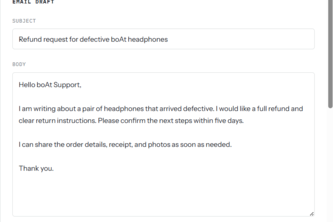
- Requesting refunds for broken items.
- Chasing landlords about deposits.
- Resolving invoices from past projects.
These suggest a user base likely composed of individuals who face recurring issues with businesses or institutions that require persistence to resolve.
Evidence The author lists personal examples of tasks they wanted to automate.
Inference Based on the narrative, the ICP may be early adopters or users frustrated by bureaucratic inefficiencies in daily life. No explicit segmentation beyond self-reported usage is given.
Business Model & Pricing Evidence
There is no evidence of a business model or pricing structure in the description. The author mentions that:
- The app works offline with no API key required.
- A demo path exists without needing an account or payment.
- Real send integration and reply detection are planned features.
Evidence The author states the app currently runs without accounts, databases, or payments.
Inference If monetized, it might involve premium tiers for advanced escalation rules, real email sending, or broader jurisdiction coverage. No current pricing or monetization strategy is described.
Technical & Delivery Signals
The system is built using:
- TypeScript
- Next.js App Router
- React
- Tailwind CSS
- Zustand (state management)
- Zod (validation)
- Vitest (testing)
- Vercel (deployment)
Key technical elements include:
- Stateless server routes for API key handling.
- Structured Outputs with Zod schema validation.
- Pure TypeScript modules with injected clocks.
- Escalation logic implemented as a state machine.
- Use of Codex for code generation, with contracts per task.
Evidence The author details the tech stack and implementation approach.
Inference The architecture suggests a lightweight, client-side-first solution that could scale to serverless or cloud functions. No evidence of scaling challenges or infrastructure complexity is provided.
Traction & Maturity Signals
There is no evidence of traction, revenue, customers, or adoption beyond the author’s own use case. The project is described as a hackathon submission and lacks any data on:
- Number of users.
- Revenue streams.
- Customer retention.
- Product usage metrics.
Evidence The description is limited to the author's personal experience and development process.
Inference As a hackathon project, it likely has minimal traction or maturity. No evidence of product-market fit or user feedback exists.
Competitive Context
The description does not mention competitors or direct comparisons. However, based on the functionality:
- It overlaps with task automation tools like Todoist or Notion.
- It shares similarities with AI-powered email drafting tools (e.g., Grammarly, Jasper).
- It may compete with niche personal productivity apps that focus on persistence or follow-up.
Evidence No mention of competitors or competitive landscape.
Inference The tool is positioned as a novel approach to task initiation and escalation, but no evidence exists of existing solutions or market positioning.
Open Questions & Risks
- Unverified claims: All functionality described is self-reported; no independent validation.
- No traction or users: No evidence of real-world adoption or customer feedback.
- Limited scope: The tool works offline and without accounts, which may limit long-term viability.
- AI dependency: Heavy reliance on GPT-5 and structured outputs raises concerns about consistency and cost.
- Lack of monetization strategy: No indication of how the product will generate revenue.
Evidence The author acknowledges limitations in demo constraints and lack of real-world testing.
Inference Without traction or clear monetization, this remains a prototype rather than a viable business.
Questions the description leaves open
- What specific legal references or leverage rules are currently implemented?
- How does the tool handle edge cases where intent is unclear or ambiguous?
- Are there plans to integrate with real email services or communication platforms?
- Has the author tested the escalation ladder with actual users or in real-world scenarios?
- What is the long-term vision for monetization and scaling beyond the current prototype?
Evidence These questions aim to probe unaddressed aspects of the product’s design, implementation, and future direction.
Inference These are critical to assess whether the tool moves from concept to viable product.
Overall Assessment
There is no evidence of a functioning business or product ready for investment or partnership. The project is described as a hackathon submission with no revenue, customers, or traction.
Evidence The description is limited to author’s own account and technical implementation.
Inference While technically interesting and conceptually aligned with emerging trends in task automation, it lacks commercial viability indicators at this stage. It may evolve into something valuable but is not yet a candidate for investment or strategic partnership.
User Stories BotA demo video on every pull request
Get a demo video on every new feature
GitHub App that watches your pull requests and records a narrated, captioned demo.
Save time on demo prep and make informed decisions faster with a video walkthrough of every new feature.
Source
Submitted to the OpenAI 2026 hackathon on Devpost. Project home on Devpost. Back to the full gallery on Devpost.
This competitive analysis was produced by top-founders.com (opens in a new tab)
Generated by a language model from this project's public Devpost page — its tagline, the author's own write-up and any built-with tags listed there — as captured in August 2026. Short quotations are the author's words. It is an opinion on the idea as a business, not on the people behind it, and it reflects the description as published then. If the project has moved on, request a correction below. The analysis is not independent research and contains no verified traction, revenue or customer data.
An independent guide by KFG International LLC — not affiliated with, endorsed by, or connected to Devpost or OpenAI.